
A professional website in Australia typically costs between $3,000 and $25,000+, depending on size, complexity, and who builds it. A simple five-page small business website built by a freelancer might cost around $3,500, while a custom ecommerce platform developed by a Sydney agency can exceed $25,000. Template-based DIY options exist from $0 to $500, but they come with meaningful trade-offs, which this guide unpacks in full.
There is no shortage of pricing articles that open with vague ranges and close with an invitation to “get in touch.” This is not that. What follows is a genuine breakdown of what drives website costs in Australia in 2026, what you should expect for your budget, and where the real risks sit.
How website pricing actually works
Most people expect a fixed-price list for websites, the way they would for a plumber or a signwriter. That is not how it works, and understanding why will save you from sticker shock and bad decisions.
Website cost is determined by a combination of four core variables.
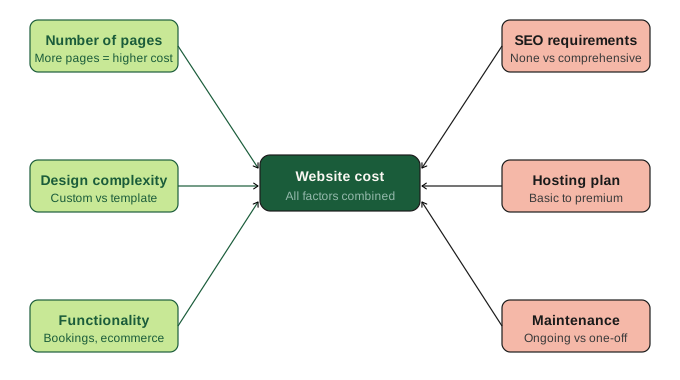
Scope is the biggest one. How many pages, how many features, how complex is the content? A five-page brochure site requires a fraction of the labour involved in a 50-page ecommerce store with booking, payment, and inventory management. Agencies price against time, and scope drives time.
Who builds it matters more than most people realise. A junior freelancer, an experienced solo developer, and a full-service agency all produce different outputs at different price points. A Sydney agency with a senior team, a project manager, and a dedicated developer has higher overheads than a freelancer working from home in regional Queensland. Both can produce good work. They are pricing different things.
What is included is where comparisons fall apart. Some quotes bundle hosting, domain registration, SEO setup, and 12 months of support. Others are build-only. A $4,500 quote that includes all of that might represent better value than a $3,200 quote that does not. Always ask what is in and what is out before you compare.
Ongoing costs are consistently underestimated. The build price is a one-time cost. Hosting, maintenance, security updates, and content changes are recurring. A site that costs $5,000 to build can easily cost $1,500 to $3,000 per year to run properly, before any marketing spend.
The process for a professionally built site typically looks like this: discovery (understanding your business, goals, and audience), proposal (scope of work with clear pricing), design (wireframes, then visual mockups), development (the approved design built into a working site), content and testing (copy, images, cross-device testing), and then launch and handover. A vague quote that skips the proposal stage is a red flag.
Types of websites and what each one costs
Static brochure website (five to eight pages)
The most common starting point for small businesses: Home, About, Services, Contact, maybe a Blog. No complex functionality, just a clear, professional online presence that tells visitors who you are and what to do next.
Real-world example: a plumber in Parramatta needs a site that shows their services, their service area in the Hills District and greater western Sydney, and a contact form. No online bookings, no login, no product catalogue. This is a brochure site. It does not need to be complicated. It needs to be fast, trustworthy, and easy to find in search.
Typical cost: $3,500 to $7,000 for a custom build. $400 to $900 for a template-based build by a semi-professional. $0 to $300 via a DIY website builder like Squarespace or Wix.
Custom WordPress website (mid-range)
WordPress powers roughly 43% of all websites globally, according to W3Techs CMS market share data. A custom WordPress build means a unique design (not an off-the-shelf theme with your logo swapped in), custom functionality, and proper SEO foundations laid from day one. It is a meaningfully different product from a template build, even if both run on the same platform.
Real-world example: a boutique accountancy firm in North Sydney wants a site with a resource library, a team profile section, and a contact form that routes enquiries to different staff. Off-the-shelf themes will not handle this cleanly without significant workarounds that introduce fragility. A custom WordPress build handles it properly.
Typical cost: $7,000 to $15,000.
Ecommerce website
Selling products online adds significant complexity: product pages, inventory management, shopping cart, payment gateway integration, shipping calculations, returns handling, and customer account management. Each of those is a separate development task. The integration work alone – connecting the store to Xero, Australia Post, and Afterpay – can add thousands to a quote.
Real-world example: a Sydney-based clothing brand launching online needs a WooCommerce or Shopify store with 200 product SKUs, size and colour variants, a returns portal, and integration with their accounting software. This is not a $3,000 job, and any agency quoting it at $3,000 is either cutting corners or not understanding the scope.
Shopify’s transaction fees range from 0.5% to 2%, depending on the plan selected, in addition to monthly subscription costs. WooCommerce is free to install, but not free to run. Quality hosting, premium extensions, and developer time for setup and maintenance add up fast.
Typical cost: $8,000 to $25,000+ for a custom build. Platform fees apply on top and recur monthly.
Landing page
A single-page site built for one purpose: converting a visitor into a lead or a sale. Common for product launches, service promotions, or campaigns running paid traffic.
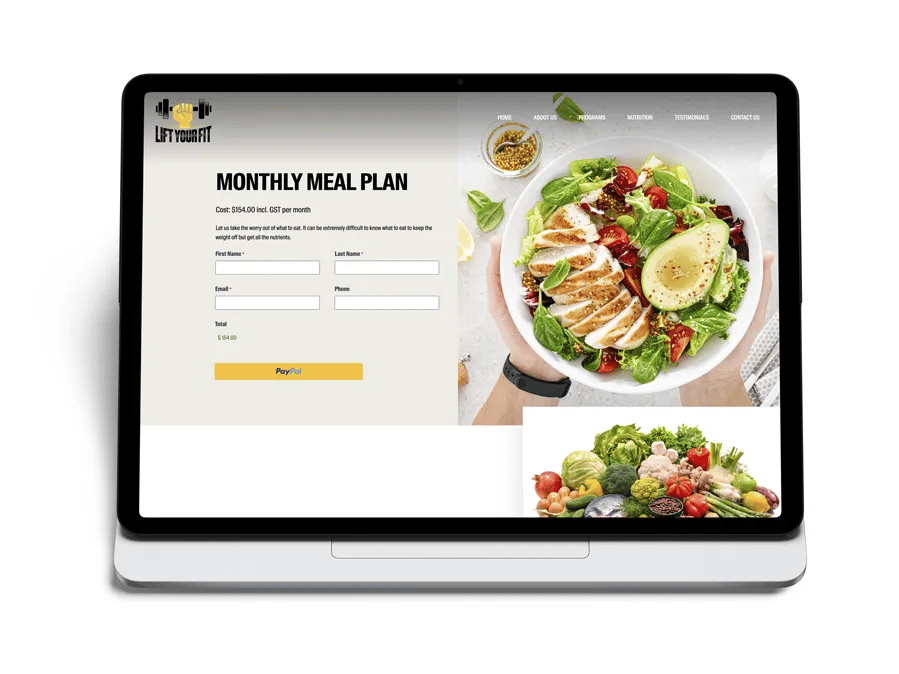
Real-world example: a personal trainer in Bondi Junction running a 12-week transformation challenge wants a page with a strong hero section, testimonials, program details, an FAQ, and a sign-up form connected to Mailchimp. One page. One goal. Everything else is a distraction.
Typical cost: $1,500 to $3,500.
Web application or custom platform
Beyond standard websites into software: booking platforms, client portals, membership sites, SaaS tools, or marketplace platforms. These are software development projects that happen to run in a browser. Pricing them like a website is a common and expensive mistake.
Real-world example: a national childcare provider needs a parent portal that allows families to view attendance records, pay invoices, and message educators. This is a web application with a database, user authentication, role-based permissions, and API connections to their management software. It is not a website.
Typical cost: $20,000 to $100,000+, with ongoing development and infrastructure costs well above what a standard website incurs.
Estimate your own project cost
If you want a personalised number before reading further, the calculator below factors in pages, design complexity, SEO, functionality, and hosting. It takes about 60 seconds.
Instant Website Design Cost Calculator
Total
Includes:
- Uniquely crafted design from ‘scratch’
- WordPress CMS
- Google Analytics Setup
- Social Media Integration
- Images Slideshow
- Photo Gallery
- Hover/Active Effects
- Testimonial Slider
- Enquiry Form
Website design prices in Sydney
Sydney sits at the higher end of Australian web design pricing, and by a meaningful margin. Higher rents, higher wage expectations, and a concentration of clients with larger budgets mean Sydney agencies and freelancers typically charge more than their counterparts in Brisbane, Adelaide, or regional areas. Here is what Sydney businesses are actually paying in 2026:
| Website type | Typical Sydney price range |
| Small business website (5 to 8 pages) | $3,500 to $7,000 |
| Mid-range custom WordPress site | $7,000 to $15,000 |
| Ecommerce website | $8,000 to $25,000+ |
| Landing page only | $1,500 to $3,500 |
| Freelancer (all site types) | $2,500 to $6,000 |
| Sydney agency (all site types) | $4,000 to $20,000+ |
These ranges reflect custom-built sites from Sydney-based designers and agencies. Template-based builds and offshore developers will always be cheaper, but the trade-offs are real and covered below.
Why is Sydney more expensive? A web designer working out of a studio in Surry Hills or Chippendale pays Sydney commercial rent and hires at Sydney salary rates. Those overheads are baked into the quote. A full-service agency with 10 staff — including designers, developers, a project manager, and a copywriter — has significantly higher operational costs than a sole trader. That is reflected in what you pay. It is not arbitrary.
Freelancer vs. agency in Sydney: A freelancer is typically one person handling design, development, and sometimes copy. Lower overhead means lower prices, often $2,500 to $6,000 for a small business site. The trade-off is capacity. If your project scope grows, or they are deep in another client project, your timelines slip. A Sydney agency brings a team and a structured process, typically starting at $4,000 and running past $20,000 for larger projects. Neither is automatically the better choice. It depends on the complexity of what you need and how much ongoing support you will require after launch.
Is offshore development worth it?
Offshore development can dramatically reduce upfront cost. A developer in the Philippines, India, or Eastern Europe may charge a fraction of equivalent Sydney rates, sometimes as little as $15 to $30 per hour versus $100 to $180 for a senior Sydney developer. For straightforward builds using established templates, offshore can deliver acceptable results.
The risks are worth knowing clearly. Communication delays across time zones slow down feedback cycles and complicate testing. Quality is genuinely variable. The offshore market has excellent developers and very poor ones, and distinguishing between them before you have signed a contract is difficult without technical expertise. Local market knowledge is limited. A developer in Eastern Europe does not know that your target audience in Crows Nest skews differently to your competitor in Manly.
Most importantly, there is no ongoing relationship. If something breaks at 9am on a Monday before a major pitch, a Sydney-based team is reachable, invested in your outcome, and understands the urgency. An offshore contractor may respond 24 hours later, if at all. For businesses where the website is a genuine revenue driver, the price premium for local is usually justified.
Who needs what kind of website
Trades and local services such as plumbers, electricians, concreters, and cleaners have a simple goal: appear in Google when someone in your suburb searches for your trade, and give them a reason to call rather than scroll past. A five-to-eight page brochure site with a clear phone number, a defined service area, and genuine customer reviews achieves this. Spending $15,000 on an elaborate custom site will not increase call volume if your audience just needs reassurance that you are legitimate and available.
What to budget: $3,500 to $6,500.
Professional services, including accountants, lawyers, consultants, and financial planners, trade primarily on trust, and the website carries significant weight in establishing that trust. The site needs to communicate expertise, credentials, and professionalism before the prospect has spoken to anyone. Blog content and resource libraries support SEO and signal the firm’s genuine depth. A custom WordPress build handles this well.
What to budget: $6,000 to $12,000.
Retail and ecommerce. Every hour of downtime or checkout friction costs measurable revenue. According to the Australia Post eCommerce Industry Report 2026, Australians spent a record $82.6 billion online in 2025 — up 14% year-on-year, with online now accounting for 24% of all retail spend. The website is revenue infrastructure, not a marketing expense to economise on. Proper payment gateway integration, mobile optimisation, and performance hosting are non-negotiable.
What to budget: $8,000 to $25,000+ for the build, plus ongoing platform and maintenance costs.
Hospitality covering restaurants, cafes, accommodation, and function venues commonly need table booking integrations (OpenTable, ResDiary, or direct systems), menus formatted for mobile, gift voucher functionality, and event pages. Most restaurant website visits happen on a phone. A site that looks great on a 27-inch iMac but breaks the layout on an iPhone 15 will cost you bookings.
What to budget: $4,000 to $10,000.
Health and wellness practices, including physiotherapists, psychologists, GPs, and gyms, face more technical complexity than most people expect. Appointment booking, contact forms designed with patient privacy in mind, and telehealth integrations all add scope. Practitioners also need to ensure their website does not make claims that breach AHPRA or TGA advertising guidelines. The relevant rules are more specific than most people realise, and non-compliance has real consequences.
What to budget: $5,000 to $15,000.
Key elements that influence your final cost
Domain name
Your domain is your address on the internet. A .com.au domain typically costs $10 to $15 per year from registrars like VentraIP or Crazy Domains. Premium domains, such as short, memorable, or exact-match keyword domains, can cost thousands on the secondary market. For most businesses, a clean, brand-aligned domain at the standard rate is fine.
Hosting
Hosting is where your website files live, and it matters more than most business owners realise. Poor hosting slows your site, harms its search rankings, and exposes it to security risks. The main options in Australia in 2026:
- Shared hosting: $5-$30 per month. Fine for low-traffic brochure sites. Multiple websites share a single server, so if a neighbour experiences traffic or a security incident, performance across the server can suffer.
- Managed WordPress hosting: $25 to $100 per month. Optimised specifically for WordPress, with better support, automatic backups, and performance tuning built in. Recommended for business websites that need to be fast and reliable.
- VPS (Virtual Private Server): $30-$150 per month. Your own isolated environment on a shared physical server. More control, more responsibility.
- Dedicated server: $100-$500+ per month. The entire physical server is yours. Only necessary for very high-traffic sites.
Australian hosting with servers physically located in Australia generally performs better for Australian audiences due to lower latency. Worth specifying when you ask for quotes.
Functionality and integrations
Every feature adds cost, both in initial development and in ongoing maintenance. Common additions and their rough price impact:
- Blog: minimal if WordPress is the platform, it is already built in
- Contact forms with conditional logic: $200 to $800
- Online booking (Calendly integration versus a custom system): $500 to $3,000
- Ecommerce (basic product catalogue and checkout): adds $3,000 to $8,000+
- Membership or login area: adds $3,000 to $10,000+
- Custom API integrations (CRM, accounting software, ERP): $1,500 to $10,000+
The mistake most businesses make is adding features during the build rather than planning them from the start. Mid-project additions are always more expensive than features scoped upfront.
SEO setup
A site built with proper SEO foundations, including clean URL structure, correct heading hierarchy, optimised images, a working sitemap, and properly configured robots.txt, costs roughly the same to build as one without those things. Remediation after the fact is expensive and time-consuming. Basic on-page SEO should be included in any professional build as standard. Ongoing SEO, including keyword research, content strategy, link building, and technical audits, is a separate, recurring engagement.
Risks and limitations to understand before you sign
The quote that seems too good to be true. A $999 website from an overseas marketplace or a local operator undercutting the market is almost always built on a generic template with minimal customisation, no strategy, weak SEO foundations, and no support after launch. It may look acceptable on the day it goes live. Within 12 months, you will likely be looking at remediation work that costs more than a proper build would have.
Scope creep. Projects expand. “Can we add a photo gallery?” “Can we connect the booking system?” “Actually, we need the blog too.” Each addition is a legitimate cost. If your contract lacks a clear scope of work and a documented process for handling changes, costs can balloon unpredictably. Get everything in writing before work begins, and read it before you sign.
Ongoing costs are consistently underestimated. The build cost is just the starting point. Realistic annual running costs for a professionally maintained small business website in Australia include hosting ($250 to $1,500 per year, depending on traffic and requirements), domain renewal ($15 to $100 per year), and maintenance and updates ($500 to $3,000 per year). Content updates and SEO are on top of that, and they vary widely depending on how actively you invest in organic growth.
Platform lock-in. Squarespace and Wix both make it difficult, and in some cases impossible, to migrate your content to another platform if your business outgrows them. If that day comes, you are rebuilding from scratch. WordPress is open source and portable, which is one of the reasons agencies recommend it to businesses that expect to grow.
SEO takes time. A new website does not automatically appear in Google search results. Google itself is clear that SEO is a long-term investment. The timeline from launch to meaningful organic traffic is typically 6 to 18 months, depending on the market and the competitiveness of the search landscape. Any agency guaranteeing first-page rankings within 30 days is making a promise they cannot keep.
Your guide to DIY versus professional options
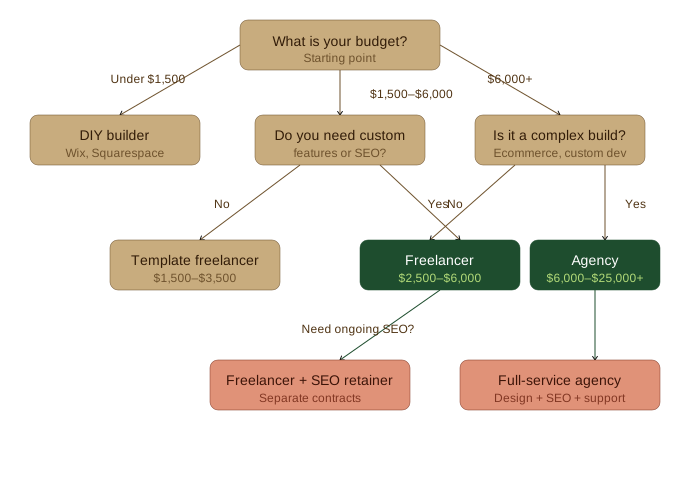
| Option | Upfront cost | Ongoing cost | Typical quality | Best for |
| DIY website builder (Wix, Squarespace) | $0 to $300 | $20 to $50/month | Variable | Hobby, early-stage testing |
| DIY WordPress | $50 to $300 | $20 to $80/month | Variable | Tech-savvy solopreneurs |
| Template + freelancer | $400 to $1,500 | $20 to $80/month | Moderate | Budget-conscious small businesses |
| Custom WordPress (freelancer) | $2,500 to $6,000 | $80 to $200/month | Good | Small to medium businesses |
| Custom WordPress (agency) | $5,000 to $20,000+ | $100 to $500/month | High | Businesses with revenue at stake |
| Custom web application | $20,000 to $100,000+ | $500 to $5,000/month | High | Complex platforms and software |
Common questions answered directly
What is the cheapest way to get a professional website in Australia?
The cheapest route to a genuinely usable site is a template-based WordPress build using a quality premium theme ($50 to $200) on a reputable Australian host ($20 to $50 per month). If you are willing to invest 20 to 40 hours learning the platform and setting it up yourself, total annual costs can stay under $1,000. The trade-off: your time has real value; self-built sites often have inconsistent design and weak SEO; and scalability becomes a problem quickly.
How long does it take to build a website in Australia?
For a professionally built small business website, four to eight weeks from signed contract to launch is a reasonable expectation. Complex ecommerce or custom application projects typically take 3 to 6 months. Delays almost always come from the client side — including slow content delivery, unavailability for feedback, or scope changes mid-project. If you want your site launched quickly, have your content ready before the build starts.
Do I need to pay for ongoing website maintenance?
Yes, if you want the site to remain secure, fast, and functional. WordPress releases core updates regularly, and security vulnerabilities in outdated plugins are one of the most common ways websites get compromised. Maintenance plans from Australian agencies typically cost $100 to $500 per month and cover updates, backups, uptime monitoring, and minor content changes. It is not optional if the site matters to your business.
Should I use Shopify or WooCommerce for my ecommerce store?
Both are legitimate platforms with different strengths. Shopify is hosted with no server management required, has excellent support, and is faster to get up and running. It charges transaction fees and is harder to customise deeply. WooCommerce is free to install but not free to run — hosting and extensions add up. It is infinitely customisable, and being built on WordPress makes content management and SEO significantly easier for most business owners.
For businesses turning over less than $500K online per year, either platform works well. Above that, the choice should be driven by specific operational requirements — your fulfilment workflow, your accounting integrations, and your team’s technical comfort — not platform loyalty or what your developer happens to prefer.
What does a $500 website get me in 2026?
A template-based site, either on a DIY platform or a basic WordPress installation using a free theme. Adequate for a hobby project, a personal blog, or a business in its earliest stages, testing whether there is demand. Not adequate for a business that relies on its website to generate revenue or build credibility in a competitive market.
How to get the best result for your budget
Define your goals before you talk to anyone. Are you trying to generate phone enquiries? Sell products online? Build an email list? Rank for local search terms in your suburb? Your goal determines the right type of site and what success looks like. Without a clear goal, agencies are guessing, and so are you.
Get at least three quotes and compare scope, not just price. A $5,000 quote that includes hosting, SEO setup, and 12 months of support may be a better value than a $3,500 quote that includes none of those things. The numbers are meaningless without understanding what lies behind them.
Ask for examples of comparable work. A portfolio of restaurant websites tells you nothing about an agency’s ability to build a complex ecommerce store. Ask to see work that is genuinely similar to what you need — in industry, in complexity, and in budget.
Understand what happens after launch. Who handles security updates? What is the process for fixing bugs? What is the average response time for support requests? If the agency cannot answer these questions clearly, the post-launch relationship will be frustrating.
Prioritise mobile and speed. Google uses mobile-first indexing. The mobile version of your site is what determines your search ranking, not the desktop version. A site that looks great on a 27-inch monitor but breaks on an iPhone will underperform in search and lose visitors. Ask specifically about mobile testing and Core Web Vitals scores in the delivery checklist.
Do not skip the discovery phase. Agencies that move straight from enquiry to design without properly understanding your business, your customers, and your competitive landscape tend to produce generic work that needs to be redone. Even a single 90-minute briefing session prevents significant rework later.
Reserve budget for content. Professional photography, copywriting, and video are consistently the things that derail website launches. Either budget for them properly or commit to producing them in-house before the project starts, not during it.
Reduce scope intelligently when you need to cut costs. If you are over budget, launch a smaller site well rather than a larger site poorly. A five-page site with excellent copy, fast load times, and a clear call to action consistently outperforms a 20-page site with thin, placeholder content. You can always add pages later.
Why the investment matters
A well-built website generates enquiries, answers customer questions, and builds credibility around the clock without staff costs. For most small businesses, the return on a professional website exceeds almost any other marketing channel over a three-year horizon, particularly when organic search traffic compounds over time.
Unlike social media reach or paid advertising, your website and its search rankings are owned assets. Algorithm changes on Instagram or rising costs per click on Google Ads, do not erase years of organic search investment. A properly structured, SEO-optimised site launched in 2026 and consistently maintained will generate qualified leads in 2027 and 2028 at no cost per click.
The practical reality is this: a slow, dated, or clunky website signals to a prospective customer that the business behind it might be the same. A fast, well-designed site with clear messaging signals that you take your work seriously. In competitive markets, which describe most of Sydney that impression is formed in seconds and directly affects whether someone picks up the phone or clicks back to the search results.
What to expect from Keen To Design
We are a Sydney-based web design agency. Our typical projects range from $3,400 for a professionally built small-business site to $15,000 and above for custom WordPress builds and ecommerce projects. Every project starts with a proper discovery process, and every quote is itemised, no vague scopes and no surprises.
If you want a realistic estimate for your project before committing to a conversation, our website cost calculator walks you through the variables and gives you a ballpark based on your actual requirements.
Pricing ranges in this article reflect the Australian market as of 2026. All costs are in AUD. Individual quotes will vary based on scope, provider, and specific project requirements.
